 This work is licensed under a Creative Commons Attribution-Noncommercial-No Derivative Works 3.0 New Zealand License


Menu
2014 Field Tour to Singapore and Malaysia
Neil Challenger reflects on the fieldtour he recently led to Singapore and Malaysia.
Last semester the School of Landscape Architecture took a two week fieldtour to South East Asia, which was attended by 23 students who still have the smile on their face to prove they went away. The trip focused on publically accessible sustainability (as opposed to fenced, inaccessible sustainability) and was in two halves – dense, very populated but surprisingly green Singapore and fecund, incredibly green and sparsely populated Sarawak in East Malaysia. This gave us two settings that were almost polar opposites from each other in terms of landscape pressure, numbers of site users and sizes of budget. In Singapore this allowed us to visit roof-gardens and green-walls, the two billion dollar Gardens by the Bay, parks designed for water harvesting, eco-parks and a two kilometer tree top walk. An impressive amount for a 650km2 island with over 5 million inhabitants. Summing this up the students applying the techniques they had seen through a site design project they did with students from the Singapore Polytechnic Landscape Architecture programme.
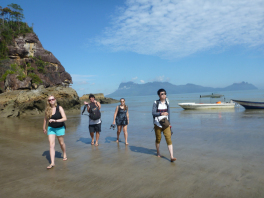
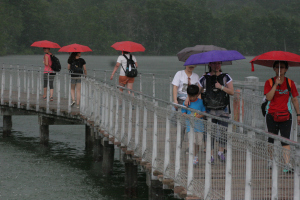
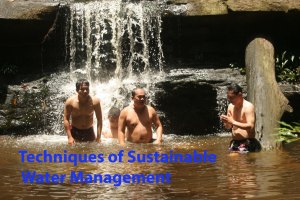
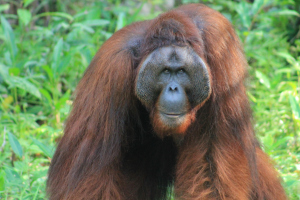
In contrast, with its extensive forests and small human population, the sites in Sarawak were generally exponentially larger, but with far fewer users and far smaller budgets, giving us a very different set of sites to visit. Here the group visited National Parks, wildlife sanctuaries (those Orangutan can really move) and most strikingly Sarawak’s planted forest zone which has been established to balance production forestry, conservation and indigenous land rights over a whopping 450,000 ha of forest lands! This was a major focus of the trip and the group spent two nights in a jungle camp working with staff from the conse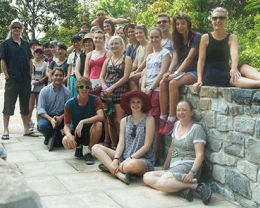 rvation arm of the Grand Perfect Forestry Corporation (yes that is the corporation’s name), looking at both conservation and production sites, long houses, swimming holes and waterfalls. In the end they did an applied project using design to explore the viability of adding eco-tourism to the mix of the land uses managed for in the zone. A different and potentially powerful vision of accessible sustainability.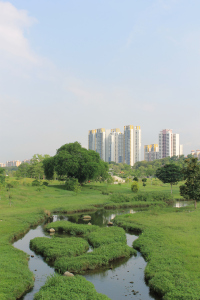

Punctuating all of this was fine food (including chicken’s feet – not to everyone’s taste), rice wine (again not a guaranteed sale), swimming, some serious shopping and much hilarity. In Borneo we saw some of the largest insects on the planet including a tarantula and scorpion, and, less intimidating, butterflies and moths so large that you felt it when they landed on you. There were also some alarmingly named creatures such as the green death adder – luckily asleep at the time. It was hot, sweaty, surprisingly hard work, but a lot of fun, very interesting and a memorable trip with some great learning showing that sustainability can be accessible, and giving us models that can be applied in New Zealand.
[The trip was led by Neil Challenger with the help and support of Erica Gilchrist and Antony Shadbolt. The support of the School of Landscape Architecture and the Faculty of Environment Society and Design is gratefully acknowledged, as well as that of the numerous people who worked with us while we were away, of whom there are too many to mention by name. But we know who you are and greatly appreciate your help.]